Immortal inspiration
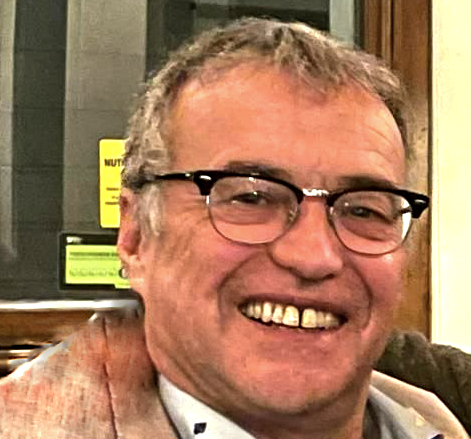
A tribute to Phil Woolas – boss, mentor and friend.
“I’ve a dozen white horses and a donkey on their way up to you in Edinburgh, can you locate somewhere to stage a procession tomorrow – oh, and you will need to find some European flags”. I had received many improbable instructions in Phil Woolas’ distinctive Burnley twang, but this was the most unusual, and ultimately the most successful.
It was December 1992 and heads of state from across the European Union were in the Scottish capital for a summit. Phil wanted a stunt to publicise the demand for the UK to adopt more workers’ protections from Europe. He was at that time head of communications at the GMB, a job to which he had been appointed when he promised general secretary John Edmonds that he could ‘get the union on the ten o’clock news’.
With no time for permissions, I decided that Carlton Hill would fit the bill. One of Edinburgh’s distinctive rocky outcrops, you can drive to the summit on public roads, it was usually pretty deserted, and it was a short walk from the conference venue.
Later that day, but before the horses or flags were in my hands, I drafted a press call and distributed it among the hundreds of journalists gathered to cover the summit. To my surprise, what I had initially taken for a crazy idea was well received. Television crews from across the continent were soon pestering me for further details and suggestions for camera positions.
Early the next day, I met a man driving a large mechanised horse box on the windy hilltop and tied the flags of France, Germany, the Netherlands, Spain, Portugal, Greece, Luxembourg, Denmark, Belgium, Sweden, Italy, Ireland and Austria to his huge white horses. To the donkey’s hind, I roped the Union Flag. Our press release accused the UK government of frustrating the implementation of EU rights that would improve workers’ safety. By the time the horses paraded in circles, there were dozens of television crews. We appeared in news broadcasts all over the continent and, critically, featured in the lead story on the BBC’s ten o’clock news.
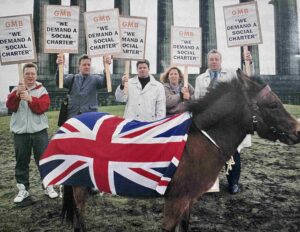
(I am second from the left.)
The insight Phil brought to these campaigns was that television news is hungry for pictures. Of course the EU Summit would be lavishly covered, but endless suited politicians speaking from lecterns made for boring broadcasts. Horses and flags delivered pictures that forced the media to mention our campaign, despite it being unrelated to the business of the summit At such work, Phil was a master. Geese, pigs and sheep were all roped into photo opportunities at company AGMs and the like. A lavish ‘tea party’ at the Dorchester even got a line about the GMB into coverage of Bill Clinton’s inauguration.
He was just as adept at more cerebral campaigns – notably mining government databases to create national media releases based on data specific to Westminster constituencies or local government areas. Every newspaper in the UK had a story unique to their patch, all supporting whatever was the GMB’s issue of the day.
I had first met Phil at a Labour Students event in Bradford. He was president of the National Union of Students (NUS), I was a first-year undergraduate. Despite this, he took an interest in my views, and with a lavish flourish gave me a compliments slip ‘from the office of the President’ with a hand-written instruction that I should be admitted to the following week’s NUS conference.
So began an association during which he three times appointed me to edit magazines and hired me as Labour’s ‘BT Gold man’ during the 1992 general election campaign. I was known by the means that transmitted my work to the party’s 650 candidates. The job, however, was to draft the twice daily ‘lines to take’, that were approved by the campaign management committee and sent on some kind of pager to all election hopefuls.
It was during this month of 100 hour weeks that I really understood what a political talent Phil was. His intelligence from inside other parties’ campaigns routinely took my breath away. His surefooted anticipation of the consequences of events, or ways to turn attention to Labour’s priorities was dazzling. His campaign instincts had been honed over decades, but he built on supreme natural talents.
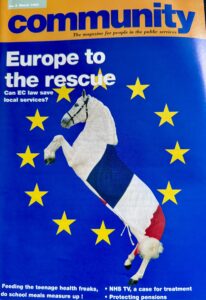
Photo © Graham McGirk
What skills I possessed seemed modest by comparison, but Phil always heard my ideas with respect and interest and treated me as an equal. He was also deeply kind, and great fun to be around – if you could ever keep him still for long enough to enjoy down time.
Long after the days when we often worked closely together, he would call me occasionally to ask if I would draft a speech, or a campaign website. ‘We could do it here, but I need something that really sparkles, and I thought of you’, he would say. It was flattery enough for me to always contribute my best effort.
To lose him so young is tragic. My heart goes out to his wife Tracy and sons Josh and Jed. I have no idea if Phil was religious, but I have no doubt that he is immortal. Of our generation who emerged from student politics in the 1980s, few others inspired, encouraged, and enabled so many. The competence, determination and imagination with which he infused his politics animated us all. We carry it with us and will have already passed it on in innumerable actions. Those qualities will be his legacy and they will burn bright for all time.
At the conclusion of the Edinburgh stunt, I helped the owner return his stable to their mobile stalls. The old horse man had been impressed. “When I started out this morning, I assumed that this was some kind of fools errand”, he told me. “But my horses have never had so many cameras pointed at them. Whoever had this idea was some kind of genius”. More than three decades on, that seems a fitting epitaph.